What makes a company successful?...
... delivering products and services that are relevant and create impact among consumers.
I combine my expertise as a Marketing executive in a Fortune 500 company and my passion as an investor to find the Companies that I think have "cracked the code" with consumers. Advertising does work. When I see a new product that fits relevant consumer trends, and that is supported with a campaign that I find particularly shrewd and innovative, I know that Company is potentially a great investment.
One of the great investors of all times, Peter Lynch, recommends to "buy what you know". You watch TV, go to the supermarket and walk around everyday. Observe... look around: what you see can make you money in the stock market. Now, let's be clear: a Company is not good just because it advertises. What we have to look for is great products supported with -and enhanced by- great advertising. The principle is simple: if something is good enough to draw your interest, it will be of interest to millions of persons just like you.
It is my goal to share with the reader my findings in the world of marketing which I think will turn into great returns for investors. Profit from it!
Monday, February 28, 2011
Apple: The Leader That Others Continue to Follow
Posted by
Rafael Grillo
at
2:57 PM
0
comments
Labels: AAPL
Friday, February 11, 2011
Nokia, Apple: New strategies spell opportunity
Sprint's Competitive Strengths
I believe Sprint (S) has several competitive strengths that define a far more robust competitive position than many might want to give it credit for. Those strengths are a) compelling plans that are well communicated to consumers; b) superior customer service; c) the increasing popularity of Google's (GOOG) Android; and, related to that, d) Sprint’s strong line-up of popular Android phones.
I discuss these strengths in a Seeking Alpha article with the title "Sprint Earnings Preview: Competitive Strengths to Drive Results".
Posted by
Rafael Grillo
at
9:27 AM
0
comments
Tuesday, February 1, 2011
Ford: in the driver's seat
Posted by
Rafael Grillo
at
2:07 PM
0
comments
Labels: F
Wednesday, January 26, 2011
Stocks To Benefit From an Increase in Consumer Confidence
Posted by
Rafael Grillo
at
7:59 AM
0
comments
Monday, January 24, 2011
Dell, Hewlett-Packard and the Future of the PC
I address this category in a recent article in Seeking Alpha, entitled: "Dell, Hewlett-Packard and the Future of the PC".
Posted by
Rafael Grillo
at
12:56 PM
0
comments
Wednesday, January 19, 2011
Lululemon Athletica: Driven by fundamental trends
"At Lululemon's store yesterday. Great consumer experience. More to come on LULU."
I never got to write the article I intended to on Lululemon Athletica (LULU). At that time, the share price for LULU was $32. Yesterday it closed above $70.
In an article I just published in Seeking Alpha, entitled "Lululemon Athletica: A Great Consumer Experience Has This Stock Rising" I explain what I think is so right about Lululemon’s consumer experience and why I believe it is not too late to invest in this superb retailer.
Posted by
Rafael Grillo
at
8:17 AM
0
comments
Tuesday, January 18, 2011
The need for 'more': Cisco Systems vs. Netgear
“… About 20 percent, or 1 in 5, sets of wireless networking gear is returned to stores as buyers buckle beneath the vagaries of networking.
There has been progress. It was nearly twice as hard to set up a wireless network just a few years ago, when return rates were closer to 40 percent. But even today's numbers largely represent tech-savvy consumers; many average PC users still don't even try. Ten years after they hit the consumer market, wireless networks have made it into only 30 percent of American households, report market researchers at ABI Research.”
What’s the issue? Many of us can attest that setting up a router is not that hard. Yes, we might be the tech-savvy consumers the article refers to; but I’d sustain that the real obstacle lies in the intimidating number of incomprehensible technical terms manufacturers use to describe their products and their functionalities. Both Linksys and Netgear proudly announce their products meeting the IEEE 802.11 N standard, which is superior to the B and G ones, but not to worry, because they are backward compatible… huh? So now you can have the RangeMax Dualband model XYZ-1234… HUH?
In addition, if you try to shop their line of products, the technicality of the offerings makes it really hard for the layman to understand what he is getting, if he is over-shooting against his needs, and moreover, if he is getting himself into a mess that will end up frying his hard drive, blowing up his monitor and ultimately, getting the US into WW3. And as mentioned above, a consumer faced with such enormous challenges would simply avoid making a decision.
To Cisco’s credit, in 2009 it launched a line of routers denominated Cisco Valet Wireless Hotspot
OK, now we know what the issues are. How are they to be addressed? And moreover, how can one of these companies not only get consumers to look at routers with different eyes, but moreover, activate and leverage the need for ‘more’? Based on what have been discussed so far, the winner will do the following:
- It will create a new category, with a consumer-friendly moniker, like ‘wireless Internet hubs’ or ‘wireless centrals’. Anything but ‘routers’ which is an archaic definition from the times of the corporate networked PCs.
- It will define it in terms of easy to understand, relevant dimensions. In my view, they will be a) speed: how fast my data will travel, b) range: how far away I’ll receive my signal and c) power: how many devices can I hook up simultaneously.
- It will create easy codes for each of these dimensions that consumers can understand, follow… and desire.
- Its communications will be: a) mainstream: stop advertising in techie magazines and geeky websites, b) reassuring: not focused on the gadget, but on its simple installation and the lifestyle benefits; c) consistent: follow the pattern of their consumer electronics cousins.
The definition of these relevant dimensions, and the corresponding easy to understand codes to qualifying them is what will signal consumers of the need (or desire) to upgrade. The consistent communication will keep consumers interested in and aware of the evolution of the category. If and when we see this happening, we’ll have a winner.
This is a very useful framework to scout for companies that represent an interesting opportunity for investing, and/or to assess the real potential of a new product launch or marketing initiative. Keep it in you toolbox.
Posted by
Rafael Grillo
at
9:12 AM
0
comments
Sunday, January 9, 2011
Leveraging the desire for ‘more’
Based on this precept, the implications for any marketer are obvious: engage the emotional side of the customer first. Get him to emotionally commit to your product first and just then provide him with the rational arguments for him to justify and validate his decision. If a marketer tries to win the competitive war based on the assumption of consumer rationality, he’d be choosing the harder, riskier path to success.
One of the most powerful emotional drivers ruling our consumer behavior is, simply, our desire for ‘more’. More what? Anything: better, faster, cheaper. We are helplessly compelled to want whatever we perceive is an improvement to what we already have. We want it (emotional): we can’t always justify it… or afford it (rational). Yet, this is the drive that makes us ditch perfectly fine, working cell phones, TV sets, jeans, sofas, cars to go and get the shiny new one. If emotionally we perceive there is more to be gotten, and rationally we can justify it, then we have a purchase.
While the principle might seem obvious, its execution is not that simple. The challenge for a marketer is not only creating a tangible “better” that consumers can understand and ultimately, desire, but also creating the codes to communicate it. And this is key: consumers must be able to ‘emotionally’ understand the improvement that is offered. Emotionally understand? Isn’t “understanding” an eminently rational trait? Well, not really.
Here is where I want to introduce the concept of category “dimensions” or “coordinates”. For any given product category, consumers create a sort of a mental map or space, not unlike the physical space we live in. In each of these categories, though, there are just a limited number of ‘dimensions’ that consumers use to make up their mind about what is desirable and relevant in a product. Usually there are maximum three or four of these “dimensions” that are relevant. More than that and the decisions become too complicated. Our brains abhor complexity, and when the decisions become too complicated, our tendency is to just avoid them. If the “better” is not immediately obvious, then I’d rather avoid the risk –and the associated pain- of not making the right decision. Dan Ariely covers this topic in its book Predictably Irrational
One of the best examples of how product ‘dimensions’ work and are able to drive consumer behavior is the PC market of the late 80’s, early 90’s. It is also a great example of how departing from a simple model consumers can easily “emotionally” understand creates a short circuit, and ultimately, lack of consumer interest. It is an example where a drive for rationality took over, paralyzing consumers and ultimately, hindering the growth of a Company that still today is looking for its north.
Many claim that Intel’s (INTC) stroke of genius was its “Intel Inside” campaign. That campaign turned a highly technical computer’s component into a desirable consumer brand. Intel was able to have consumers demanding PCs built with its processor, and that generated the dramatic growth that ultimately turned Intel into the uncontested leader of the processor industry it still is today. But Intel inside is just half of the story. The other half is how Intel was able to simplify for the consumers what otherwise could have been a very technical and almost ethereal category. What Intel did was to simplify the processor category for the consumers in terms of just two, simple to get, and very desirable dimensions: a) capacity and b) speed. That’s it. Along with that, it created communication codes that where easy for the consumers to follow. When PCs started making inroads into the consumer market, Intel very quickly changed the branding conventions from its processors from a technically driven nomenclature (286, 386, 486) to a cool, awe-inspiring brand name: Pentium. And for speed, Intel made sure to make news with the easy to follow clock rate in terms of Mghz. And this is exactly the point: consumer didn’t need to know what made a Pentium 2 better than a Pentium 1. They didn’t need to know what the clock rate exactly meant. These where just easy indicators for the two dimensions consumers cared about; an increase in the indicators signaled the consumers that there was something ‘better’ out there. That’s all they needed to know. And the race to upgrade started. I vividly remember the buzz among consumer when Pentium 3 was launched; or when the first 1 Ghz processor was introduced.
And then, everything just got more complicated. Suddenly, Intel launches the new Celeron processor. Consumers scratched their head: what is the difference? Should I buy Celeron or Pentium? How do I know? Pentium reached the 4 version as the last significant launch, and that was it. The race for speed stopped at 3.6 Ghz. More dimensions where introduced: the category turned complicated, technical. Decisions became difficult, and with that, consumer interest faded. The PC turned into a commodity. Yes, of course other factors came into play. But the single most important one is that, as I like to say, engineers took over.
This analysis process can be applied to any category. Then you’ll notice that those brands and companies that are able to disrupt a category are the ones that a) create one or more new dimensions in such a category that are more relevant for the consumer; and/or b) create more meaningful, easy to understand codes to communicate “better” to consumers.
Which companies are mastering this need for “more”? Just to mention a few examples:
Apple (AAPL) of course comes to mind. The lines in front of stores when a new iPhone is launched are a clear indicator of that. Apple is a master in planned obsolescence. Yet, watch out for Google (GOOG), who is threatening the iPhone supremacy by leveraging a key dimension in the smartphone arena: accessibility.
Netflix (NFLX) continues driving the key dimension that made them a disruptive force on the entertainment delivery category: ubiquity. Let me see a movie when I want it.
Microsoft (MSFT) does a good job with Office and with Internet Explorer. They also finally adopted a more meaningful code for Windows. The use of numbers will allow them to do more frequent updates to its OS that need not be tremendously onerous in terms of time and resources.
In the luxury car category, I think BMW (BMW.DE) has one of the smartest and more consistent product branding strategies. Just two numbers: size and engine power. It’s very easy to understand and shop their line-up. Lexus, Infinity, Accura and Cadillac use a series of meaningless, hard to understand combinations of letters and numbers that are impossible to commit to memory.
I will continue referring to this concept in future publications.
Posted by
Rafael Grillo
at
11:07 AM
0
comments
Labels: INTC AAPL MSFT GOOG NFLX BMW.DE
Wednesday, January 5, 2011
The Prospects for 2011
- On October 9, 2007, the Dow reached its all-time high of 14,164. Today, the Dow is hovering above 11,730. That’s barely 2,400 points or 20% of its all-time peak. If we assume we can reasonably cover half the distance this year, that puts the Dow closing 2011 at around 12,900. In a straight-line, that would mean a gain of more or less 100 points a month from now to year end. But of course it won’t be that easy. Because of the circumstances I mentioned, I think that we will have three or four short-lived corrections of around 5% each, the first of which is likely around the corner. I don’t believe we will finish January without seeing a drop in the market indicators. But these will all be buyable dips, and very much indispensable to achieve a decent return in 2011.
- I see two sectors as the real winners in 2011: Financial Services and Technology. Financials are still laggards in the recovery experimented in 2009-2010. With improved economic prospects, investors will rush to take positions in the biggest names in the sector. With regard to Technology, just two words: iPhone and Android. This is what Jim Cramer is qualifying as the “Internet Tsunami”, and on this one, I have to agree with him. Other sectors to benefit? Retail, Energy, Industrials and Commodities.
Posted by
Rafael Grillo
at
2:40 PM
0
comments
Sunday, September 19, 2010
Embracing the Zeitgeist: Apple vs. Microsoft

Nowadays, however, things have changed. The most important change is that people can choose. No, I am not talking about choosing between flavors or between different brands in a given category. Today, people can really choose: choose what to believe, choose who to relate to, choose what to care about. Ultimately, they can choose how to live their lives. The drivers of this change are very simple but very profound: a) access, and b) closeness.
In other words, globalization. Not just globalization as an economic trend or economic doctrine, but true globalization: being aware of what's going on in any part of the world the instant it's happening; not being limited by geography when choosing who to relate to or what to talk about; the empathy created by being first-hand witness –through the power of media- of the suffering and triumphs of people on the other side of the world, and ultimately, the understanding that we are all interrelated. It's never been easier or cheaper to move from one place to another. Not that long ago, self-expression and creativity was limited to those who had well-honed artistic skills.
Today, self-expression and creativity takes the form of pictures in Flickr, videos in YouTube or a page in Facebook. Suddenly a world is open for everyone and people are exposed to the myriad of experiences that life can be made of. And people today want to have them all. Like never before, life can be fulfilling and diverse and varied and exciting. There is no time to waste and certainly, no conventions to obey to. Molds have been broken, closets have been pried open and non-committal experimentation is possible. In this new world, what you need to be is secondary to who you want to be and what you want to do.
The solution is to embrace and stand for the values that fundamentally define the era we are living in and that in one way or another touch or are embraced by most people; that is, embrace the zeitgeist. In other words, praise the journey, not the destination. What is exciting about this approach is that, as a brand, once you stand for a given value or set of values, you can embrace whatever is the expression of such values at any given time and still remain true to yourself and to what consumer have learnt to appreciate in the brand.
In very simple terms, as long as you stand for music, you can play any tune. But if you stood for swing, you'd be facing very tough times in a world dominated by hip hop and country. If as a swing brand you started flirting with hip hop or country, then you'd look inauthentic and out-right opportunistic; therefore, not credible and definitely not trustworthy.
This way of defining a brand, and the consequent implications on how a brand interacts and communicates with consumers, is what I've called Marketing to the Zeitgeist.
The most influential brand of our time is, by far, Apple (AAPL). How many brands or companies are there whose endeavors are so eagerly followed by press and consumers alike? While most companies need to resort to stunts and massive PR efforts to try to attract the attention of the press, Apple's every move is news. Journalists line up to try to break the latest idea Apple is working on. We, as consumers, are simply enthralled by the succession of amazing technologies Apple makes available to us. And even those of us who don't have that many Apple products wish we had them. As an investor, there is no doubt in my mind: Apple is a core stock that must be owned and retained for the years, if not decades, to come. But why? What is Apple's spell?Many marketers and analysts have tried to rationalize it and decode it: innovation, design, courage, Steve Jobs. All those traits (except for Jobs, of course) are not unique to Apple. How do they pull them together, what sort of alchemy do they apply to combine them in such a successful proposition then?
In my view, I would summarize Apple's magic in two words: enlightenment and selflessness. Now, these are words that much rather seem to describe the Dalai Lama than a company, and that you will hardly find in any business or marketing text. They are kind of lofty and pretentious, aren't they?
The world changes around us, but we have a tendency to cling to old paradigms. More often than not, new insights are either forced to fit the old paradigms or simply, discarded as outliers. Even when new insights are gathered and understood, the second sin most companies go through is to stubbornly try to, once again, force an existing solution into meeting the new insight. Most companies develop an introspective understanding of the world, of their industry and of their own capabilities, and end up believing it as the absolute Truth. That is, we tend to fall in love with ourselves and end up drinking our own Kool Aid.
For me, one of the most blatant examples of this behavior is Microsoft (MSFT). With regard to their operating system, their last true innovation was Windows XP. Everything else has pretty much been a cosmetic improvement over the same platform. Their product, their view of the world has become so ingrained in their organizational psyche, that they basically dismiss any consumer understanding that doesn't fit their own paradigm.
To illustrate this point, think of this capital sin: they launch a Home version of Windows 7. Home, OK? For you and me, basically: fairly proficient in turning the computer on, writing a few emails and surfing the Web, but not much more. One day, you are more or less happy at your computer when an error occurs and the message that you get is an unintelligible code accompanied by a "Talk to your system administrator" instruction. I don't know you, but at home we don't tend to have a system administrator lurking around in case Windows decides to misbehave. OK, so you don't know what to do and, of course, try to see if the Help function in the system can shed any light on your problem.
Have you ever tried to use Windows Help? You need a doctoral degree in Applied Electromechanical Astrophysics just to get a shot at understanding what they are talking about. If this is their "Home" version, I don't even want to imagine the nightmares the IT guys go through with the enterprise one! The issue here? The company's focus is on the product, not on the consumers that are going to use it. What prevails is the vision and understanding of the engineers creating the software. Sure, they listen to the consumers; they have extensive ethnographic and anthropological research on how the consumers use the products. But then, they develop engineering solutions to what they perceived the consumer is asking for. They force the insights into their own paradigms. After all, Applied Electromechanical Astrophysics has become part of the pop culture, hasn't it?
So Microsoft, proud of its accomplishments (and tickled by Apple's constant snipes at them), goes and spends a fortune in media with a campaign that try to convince consumers that "Windows 7 was my idea". Yeah, right. My "System Administrator" kind of disagrees. See, you can't resolve with advertising what your product doesn't deliver. Microsoft has become an introspective behemoth that ended up believing that the world truly is what they see through the lenses they've built for themselves, and that reflects in everything they do. Windows Mobile? As clunky as the parent application. Office? Still the standard, but getting harder to use.
And Apple? Suffice to say that Apple surpassed Microsoft in market capitalization. And consistent with the case I'm making here, I'd expect that difference to continue widening in the future.
As I was saying, I'd used two very unorthodox words to describe Apple's unique recipe for success: enlightenment and selflessness.
Yet, even if this doctrine is followed to the letter, there are yet another two pitfalls that must be dealt with: exactly which consumers do we need to listen to, and how literally do we take what they say. These are two pitfalls many companies also fall into. Based on outdated marketing precepts, they think in terms of "our regular brand users" or "competitive users"; or, being a little more sophisticated, the "creative class" or the "social adventurers". Then, they take what the consumers say to the letter, and build the literal meaning of the collected insights into their decision making process. All these very easy to make mistakes will, most of the times, result in initiatives that are unsuccessful and leave everyone scratching their heads: "we did all the research… what went wrong?".
Today marketers must free themselves from the constant chatter around them, climb the proverbial mountain and scour the horizon to understand where society is going as a whole. And in seeing the direction, they need to embrace it and decide to lead it. Not fight it, not trying to steer it, but just position themselves at the forefront of the future and start building it before the rest get there. That ability to hover above and beyond the noise of the market today and understand where society is heading as a whole; to believe in what you've seen; the will to truly embrace that future and have the capacity to articulate it and to build it ahead of the arrival of society to that point, that is what I call enlightenment.
That's what Apple is doing: Apple goes beyond the interests of particular groups or segments. Apple is reading and decoding society as a whole, seeing where it is going and just delivering against it. But, wow, what a delivery!
There is where the second component of their formula kicks in: selflessness. The secret of Apple is that they simply understand that what they must deliver is an experience, not just a product. It's not about features, it's not about trying to force fit my technology or to impose my view of the world onto others. Apple is masterful at understanding the experience the consumers want, and making technology work to provide it. They don't sell operating systems, chips, memories and hard drives. They don't brag about search capabilities, speed, computing power and other technical irrelevancies. No. Apple delivers beauty, the feel of your fingers gliding on the screen, simplicity, reassurance and reliability.
At Apple, the consumer is truly the center of their attention; not a prey that needs to be persuaded to buy their fares, but the capable individual they need to serve. And in that selflessness resides their power and their dominance. Interesting, isn't it? Apple dominates by seeking to serve. And those who seek to dominate end up pushed aside.
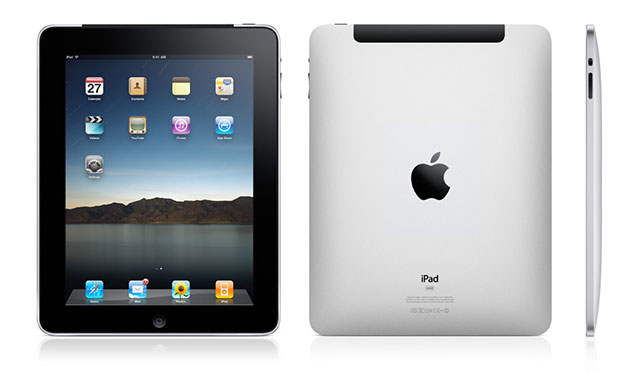
The iPad is just a superb example of that vision and and that understanding of where consumers are, where they are going and what they really want. The immediate reaction heard in the techie circles was: why would the consumers want one? It's not a laptop, not nearly as powerful; it's just a bigger iPhone that doesn't even make phone calls. And yet, consumers flocked to it.
But why? Simply, because it is the experience the consumers were longing for. Think of where laptops have been heading: smaller, lighter, netbooks. And despite these changes, you constantly hear people complaining about having to carry their clunky laptops. Think of where connectivity is going: it is a mobile world. In this small global village, consumers want… no, need to be plugged to the grid 24/7. And yet, even the mighty iPhone is rather small for most of the things consumers want to do with their connectivity.
Think of the future: what is the ideal scenario for anyone? The portability and simplicity of the phone with the comfort and power of the laptop. Some sort of cybernetic transformer that can be unfold from a small phone into a larger and spacious… what's the word? pad!... that facilitates work and fully blown entertainment anywhere. Some technologies like flexible screens will likely get us there.
But in the meantime, as we arrive there, Apple starts preparing the terrain with the iPad. Apple will take us there. Apple has become a symbol of the zeitgeist. As such, owning Apple is pretty much owning a big piece of the future.
Posted by
Rafael Grillo
at
11:38 PM
0
comments
Investing by Advertising
Posted by
Rafael Grillo
at
12:37 AM
0
comments
Tuesday, September 14, 2010
Domino’s Pizza: the impact of Authenticity, Involvement and Reciprocity
Embracing these key values demands a complete shift in the Marketing philosophy of any organization. It implies a level of honesty and openness that at times might seem counter-intuitive, if not outright suicidal. It requires a focus on –and the will to- inviting the consumers in, and allow them to actively participate in the definition of the brand. It is a commitment to doing what is right for the consumer.
Late last year, Domino’s Pizza (DPZ) chose such a path. When Patrick Doyle took over as CEO of the flailing pizza chain, he decided to address the issues face on, and launched its now famous ‘Pizza Turnaround’ initiative. The Company publicly admitted the shortfalls in its products, and made a commitment to fix them. While it was not the first time a company admitted its mistakes and vowed to fix them, what was different in the case of Domino’s Pizza was the positive energy behind the initiative, and the clear commitment the whole organization was making to be better. This was not a PR stunt; this was not a contrite CEO apologizing in a press conference. This was a group of people, real people facing a problem, overwhelmed by it and then showing the determination to fix it. Doyle himself was approachable, energetic and credible. The guy next door. Authentic.
Posted by
Rafael Grillo
at
10:01 PM
0
comments
Labels: DPZ
Friday, September 3, 2010
More on Skechers
In continuing with my investigation about Skechers (SKX) and its line of Shape-Ups shoes, I found this video clip from CNBC. I find it really exciting. Skechers is fully exploiting the potential of their radial technology. I see the current price drop as a significant opportunity to accumulate shares.
Disclosure: I own shares of SKX
Posted by
Rafael Grillo
at
7:24 AM
0
comments
Labels: SKX
Tuesday, August 24, 2010
Procter & Gamble: Old Spice's amazing turn-around
OLD SPICE, NEW TRICKS
And the MVP award for increase in body wash sales (not to mention buzz for marketing firm Wieden + Kennedy) is…the manly man himself, Old Spice guy Isaiah Mustafa. The 71-year-old brand’s current campaign, which includes hilarious TV ads and viral videos, is not only the talk of the town, it’s also being lauded as the reason behind an incredible 107% jump in sales. If you haven’t yet experienced "the man your man could smell like," check out this gem, where the shirtless wonder proposes to a woman on behalf of one of his Twitter followers.
Posted by
Rafael Grillo
at
7:30 PM
0
comments
Labels: PG
Friday, July 30, 2010
Skechers: Shape up your portfolio
Case in point: Skechers (SKX) and its line of Shape-Ups shoes. Let’s see why I am so excited about this opportunity:
Consumer need: Everyone wants to be in shape. Not everyone is willing to endure the sacrifices and hard work required to achieve that condition, though. We all know we have to exercise and promise ourselves to do it at some point. But in reality, most of us barely scratch a vigorous walk now and then. It is our natural tendency to cut corners and look for the most efficient (or shall I say ‘easy’?) way to achieve what we want. Want to lose weight? There is a pill for that. Need more energy? Let me grab the energy shot. Want more money? Let me watch Mad Money. So, the opportunity to make those rare low-intensity exercise sessions really count is irresistible.
Product proposition: “So, you are telling me I can burn more calories, improve my posture and tone my muscles just by walking in your shoes? I want in!” Skechers’ Shape-ups’ proposition is simple and has ample appeal. The key is that they have developed and positioned it for the regular people. Reebok (a Adidas AG brand) has a similar line, called EasyTone. What is the difference? Reebok targeted its shoes to the image-conscious female athlete; people who already exercise. By definition, the segment is smaller and has a lot more ‘conceptual’ competition: most of these women are mostly looking for something else in their shoes: performance, balance, avoiding injuries and so on. So, when the infrequent occasion to purchase a pair of athletic shoes finally arrives, what benefit will drive the decision? In the case of Skechers Shape-Ups, the segment is practically uncontested. For walking, most people basically use whichever pair of shoes is comfortable. But there are no special technical requirements. So Shape-Ups is the first line that offers true benefits –reason to buy- to the casual exerciser. In addition, Skechers has been careful to offer a full range of shoes for every occasion: from the cool-looking sneaker-style shoe, to the casual shoe for work. Last, the Shape-Ups shoes are not cheap: ongoing retail price is above $100 a pair, but Skechers have made sure that the quality of the shoes is commensurate to the price. Ultimately, the perception of high quality in combination with a unique functional promise is the final rational driver that consumers need to see this purchase more as an investment than an expense, therefore providing the perfect justification for an otherwise questionable outlay of cash.
Momentum: Shape-Ups is building tremendous momentum. At the stores I visited researching this product, the clerks reported brisk sales. Most importantly, consumers are raving about the comfort of the shoes in their reviews in sites like Zappos.com and Shoes.com. This viral momentum is infectious; consumers are encouraged by the positive remarks of their peers, and the momentum gains strength. My impression is that we are just at the beginning of the post-launch inflexion point in the life-cycle curve, so we should see accelerated growth for the years to come.
Posted by
Rafael Grillo
at
4:30 PM
2
comments
Labels: SKX
Sunday, June 6, 2010
A case for Sprint
My case is simple. I submit that Sprint (S) doesn’t deserve the poor reputation it has among most consumers anymore. And I expect that sooner rather than later consumers will realize that Sprint is a very smart choice. My case is based on Sprint's sound marketing and on my own experience. It’s based on alluring benefits that are difficult to resist and shortfalls that are easy to fix.- Unbeatable pricing and comprehensive plans
- Coverage that, in practical terms, is more than enough for the vast majority of people.
- A very willing customer service people, who really try to go above and beyond the call of duty to address your problems, and who seem to be empowered to solve them.
- What seems to be a solvent technical infrastructure.
What needs to be fixed?
- Their array of phones is not ideal. Palm Pre was not the killer phone everyone expected it to be. The cool factor is not completely there yet. But I am encouraged by their relationship with HTC and the series of attractive phones this company is launching.
- Administrative structure and systems that are not integrated, and likely completely outdated, that smother the good intentions of the Customer Service people, making it more difficult than necessary for them to resolve problems. The different departments in charge of sales and customer service don’t seem to be coordinated, and worst, their systems seem to be archaic, not allowing anyone to get the full picture of what’s going on with an order or an account. Consumers are simply not willing to endure frustration, and hence the bad rap about Sprint.
So, what’s the issue with Sprint? Let me very briefly summarize my own story to illustrate it:
- Sprint’s package blew away those of Verizon and AT&T. For less money than what AT&T was charging for the iPhone voice and basic data service (all other services, like text, would mean additional charges), plus two family voice lines, I got three lines with triple the shared minutes and unlimited everything –internet, texting, GPS, TV- from Sprint. That’s a dramatic value advantage for Sprint.
- So I placed my order over the internet, on the special website Sprint prepared for my company, with all the corresponding discounts. In addition, the website was featuring two additional promotions: an extra discount on the phones to be applied as two invoice credits, and a referral discount. At the moment of placing my order, I requested the porting of my old cell numbers. I am satisfied.
- One or two days later, I found that my order was cancelled and replaced by another. Phone call to Sprint: what happened? -“Not to worry, everything nominal”. Good.
- Got the phones. Porting had not taken place. Another phone call: what happened? - ” It usually takes a couple of days”. Frustrated, but, OK, let’s be patient.
- A couple of days. Phone call: what’s up with porting. - “Don’t know why it didn’t go through. Call the Porting Depmt.” And I called: -“Don’t have the request here, but let’s get it done”. Done in a matter of minutes. Somewhat upset by the slip, but since the resolution was quick and easy, I’m OK.
- First bill. No promotional discount. Call again: where’s my discount? -“what discount?”. The one in your website for my company.- “We don’t see it”. I am seeing it, in front of me. Just go to your own website.- “We have no access to our website. We need to check promotions one by one in this book” Hey, someone must have placed this promotion in your website! -“Corporate sales” Well, talk to them! “We can’t; you have to call.”. Called Corporate Sales. Same story. So, they take my word and credit the respective amount.
- Next month. Second bill. No second installment of the famous promotional discount. Repeat process.
- Referral promotion? Never showed up.
While we had a rocky beginning, ever since Sprint and I are getting along just fine. And when I compare my mobile bill with those of my colleagues, I can’t help it but to smile.
I rest my case.
Posted by
Rafael Grillo
at
11:31 PM
0
comments
Labels: S
Sunday, May 30, 2010
Apple vs. Microsoft: embracing the Zeitgeist - Part 2
Why is Apple enlightened? An old colleague, the then global Market Research guru of the company I was with at that point, had a maxim that has stuck with me through the years. It’s a very simple four-step doctrine, and yet, quite difficult to truly follow: 1) listen to your consumers; 2) listen to them again; 3) believe them; and 4) act on it. As I was explaining in the first part of this article, it is steps 3 and 4 were most companies struggle. It is where insights collide with pre-established paradigms that things go awry. Yet, even if this doctrine is followed to the letter, there are yet another two pitfalls that must be dealt with: exactly which consumers do we need to listen to, and how literally do we take what they say. These are two pitfalls many companies also fall into. Based on outdated marketing precepts, they think in terms of “our regular brand users” or “competitive users”; or, being a little more sophisticated, the “creative class” or the “social adventurers”. Then, they take what the consumers say to the letter, and build the literal meaning of the collected insights into their decision making process. All these very easy to make mistakes will, most of the times, result in initiatives that are unsuccessful and leave everyone scratching their heads: “we did all the research… what went wrong?”. As I explained in my article “The spirit of the times” , today marketers must free themselves from the constant chatter around them, climb the proverbial mountain and scour the horizon to understand where society is going as a whole. And in seeing the direction, they need to embrace it and decide to lead it. Not fight it, not trying to steer it, but just position themselves at the forefront of the future and start building it before the rest get there. That ability to hover above and beyond the noise of the market today and understand where society is heading as a whole; to believe in what you’ve seen; the will to truly embrace that future and have the capacity to articulate it and to build it ahead of the arrival of society to that point, that is what I call enlightenment. That’s what Apple is doing: Apple goes beyond the interests of particular groups or segments. Apple is reading and decoding society as a whole, seeing where it is going and just delivering against it. But, wow, what a delivery! There is where the second component of their formula kicks in: selflessness. The secret of Apple is that they simply understand that what they must deliver is an experience, not just a product. It’s not about features, it’s not about trying to force fit my technology or to impose my view of the world onto others. Apple is masterful at understanding the experience the consumers want, and making technology work to provide it. They don’t sell operating systems, chips, memories and hard drives. They don’t brag about search capabilities, speed, computing power and other technical irrelevancies. No. Apple delivers beauty, the feel of your fingers gliding on the screen, simplicity, reassurance and reliability. At Apple, the consumer is truly the center of their attention; not a prey that needs to be persuaded to buy their fares, but the capable individual they need to serve. And in that selflessness resides their power and their dominance. Interesting, isn’t it? Apple dominates by seeking to serve. And those who seek to dominate, end up pushed aside.
The iPad is just a superb example of that vision and understanding of where consumers are, where they are going and what they really want. The immediate reaction heard in the techie circles was: why would the consumers want one? It’s not a laptop, not nearly as powerful; it’s just a bigger iPhone that doesn’t even make phone calls. And yet, consumers flocked to it. But why? Simply, because it is the experience the consumers were longing for. Think of where laptops have been heading: smaller, lighter, netbooks. And despite these changes, you constantly hear people complaining about having to carry their clunky laptops. Think of where connectivity is going: it is a mobile world. In this small global village, consumers want… no, need to be plugged to the grid 24/7. And yet, even the mighty iPhone is rather small for most of the things consumers want to do with their connectivity. Think of the future: what is the ideal scenario for anyone? The portability and simplicity of the phone with the comfort and power of the laptop. Some sort of cybernetic transformer that can be unfold from a small phone into a larger and spacious… what’s the word? pad!... that facilitates work and fully blown entertainment anywhere. Some technologies like flexible screens will likely get us there. But in the meantime, as we arrive there, Apple starts preparing the terrain with the iPad. Apple will take us there. Apple has become a symbol of the zeitgeist. As such, owning Apple is pretty much owning a big piece of the future.
Posted by
Rafael Grillo
at
9:03 PM
0
comments
Monday, May 10, 2010
Apple vs. Microsoft: embracing the Zeitgeist - Part 1
The best way to start explaining my choice of words is by some quick comparative analysis: why aren’t other Apples out there? Most companies invest a tremendous amount of resources talking to consumers, gathering insights, trying to understand what is important for them. All too often, though, those insights are unconsciously sifted through previously established paradigms. These paradigms are based on the knowledge and understanding accumulated by a company or industry through the years: what worked or what didn’t in the past, previous understanding of the consumers and products, assumptions built on experience and so on. Paradigms die hard. The world changes around us, but we have a tendency to cling to old paradigms. More often than not, new insights are either forced to fit the old paradigms or simply, discarded as outliers. Even when new insights are gathered and understood, the second sin most companies go through is to stubbornly try to, once again, force an existing solution into meeting the new insight. Most companies develop an introspective understanding of the world, of their industry and of their own capabilities, and end up believing it as the absolute Truth. That is, we tend to fall in love with ourselves and end up drinking our own Kool Aid.
For me, one of the most blatant examples of this behavior is Microsoft (MSFT). With regard to their operating system, their last true innovation was Windows XP. Everything else has pretty much been a cosmetic improvement over the same platform. Their product, their view of the world has become so ingrained in their organizational psyche, that they basically dismiss any consumer understanding that doesn't fit their own paradigm. To illustrate this point, think of this capital sin: they launch a Home version of Windows 7. Home, OK? For you and me, basically. Fairly profficient in turning the computer on, writing a few emails and surfing the Web, but not much more. One day, you are more or less happy at your computer when an error occurs and the message that you get is an unintelligible code accompanied by a “Talk to your system administrator” instruction. I don’t know you, but at home we don’t tend to have a system administrator lurking around in case Windows decides to misbehave. OK, so you don't know what to do and, of course, try to see if the Help function in the system can shed any light on your problem. Have you ever tried to use Windows Help? You need a doctoral degree in Applied Electromechanical Astrophysics just to get a shot at understanding what they are talking about. If this is their “Home” version, I don’t even want to imagine the nightmares the IT guys go through with the Enterprise one! The issue here? The company's focus is on the product, not on the consumers that are going to use it. What prevails is the vision and understanding of the engineers creating the software. Sure, they listen to the consumers; they have extensive ethnographic and anthropological research on how the consumers use the products. But then, they develop engineering solutions to what they perceived the consumer is asking for. They force the insights into their own paradigms. After all, Applied Electromechanical Astrophysics has become part of the pop culture, hasn't it?
So Microsoft, proud of its accomplishments (and tickled by Apple's constant snipes at them), goes and spends a fortune in media with a campaign that try to convince consumers that “Windows 7 was my idea”. Yeah, right. My “System Administrator” kind of disagrees. See, you can’t resolve with advertising what your product doesn’t deliver. Microsoft has become an introspective behemoth that ended up believing that the world truly is what they see through the lenses they’ve built for themselves, and that reflects in everything they do. Windows Mobile? As clunky as the parent application. Office? Still the standard, but getting harder to use.
Posted by
Rafael Grillo
at
7:59 PM
0
comments
Monday, April 26, 2010
The spirit of the times
In a world regimented by the relationships we had to establish and upkeep in order to have a life, the role of branding was very clear. A brand was to project to others your personality and your character. The ensuing advertising was very straight-forward. A brand would show the type of character you wanted to portray and presto, it was selected by those who required that specific trait.In order to be successful, brands need to follow suit. Consumers today are far more complex and far more fluid than never before. A brand that defines its business, its character or the consumers it serves in too narrow of a way might soon find itself displaced and out of favor among consumers that just moved on to the next thing. The typical criteria for consumer segmentation just don’t work anymore. Demographics like gender or age or geography are simply irrelevant. Lifestyle? There are as many lifestyles as consumers out there.
As a marketer, what do you do? Successful brands need to engender familiarity, trust and a sense of consistency. They can’t be erratic. They can’t change with the wind. But at the same time, they can’t be stagnant. This is the new positioning challenge marketers are facing in this brave new world.
The solution is to embrace and stand for the values that fundamentally define the era we are living in and that in one way or another, touch or are embraced by most people. In other words, praise the journey, not the destination. What is exciting about this approach is that, as a brand, once you stand for a given value or set of values, you can embrace whatever is the expression of such values at any given time and still remain true to yourself and to what consumer have learnt to appreciate in the brand. In very simple terms, as long as you stand for music, you can play any tune. But if you stood for swing, you’d be facing very tough times in a world dominated by hip hop and country. If as a swing brand you started flirting with hip hop or country, then you’d look inauthentic and out-right opportunistic; therefore, not credible and definitely not trustworthy.
This way of defining your brand, and the consequent implications on how your brand communicates and interacts with consumers, is what I’ve called Marketing to the Zeitgeist.
Some examples, and the impact on investment decisions, will be covered in future postings.
Posted by
Rafael Grillo
at
9:00 PM
0
comments


